
Compliance rules register
Every deadline we generate, and the law it comes from.
This is the exact rule set the compliance engine runs, published in the open: 30 obligations across DSD, CIPC, the Master, SARS, labour, B-BBEE and the Information Regulator, each with the section of the Act or the SARS notice it rests on.
Sources last reviewed July 2026. Administrative norms such as bank-letter age are practice rather than statute and are configurable per organisation. Spotted something out of date? Write to hello@claripick.com and we will correct it here.
Worked example, year ending 28 Feb 2026
| Financial statements drawn up NPO Act s17(1) | 28 Aug 2026 |
| Accounting officer report obtained NPO Act s17(2) | 28 Oct 2026 |
| DSD annual report filed NPO Act s18(1)(a) | 28 Nov 2026 |
| CIPC annual financial statements Companies Act s30(1) | 28 Aug 2026 |
| SARS IT3(d) annual IT3(d) BRS | 31 May 2026 |
| PAIA annual report PAIA s83(4) | 30 Jun 2026 |
The same rules, in the product
This page is the reference. This is the screen it drives.
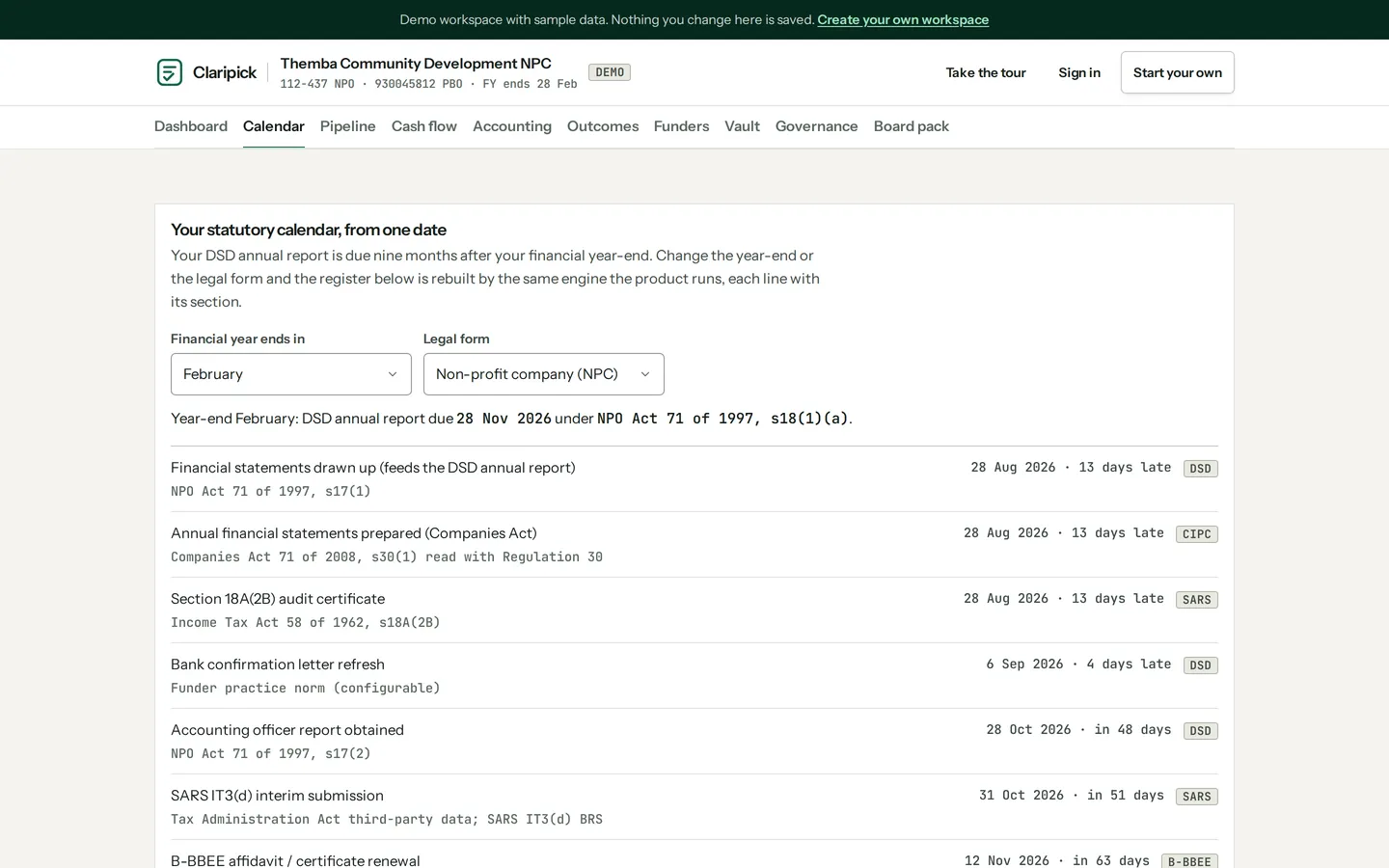
| Obligation | Citation | Rule |
|---|---|---|
| DSDDepartment of Social Development. NPO Act registration and annual reporting. | ||
| DSD annual report (narrative + AFS + accounting officer report) | NPO Act 71 of 1997, s18(1)(a) read with s17 | Due within 9 months of financial year-end via npo.gov.za. Financial statements must be drawn up by month 6 (s17(1)) and the accounting officer report obtained within 2 months of them (s17(2)). Overdue reports trigger a one-month s20 compliance notice, then cancellation under s21 — with a one-month window to appeal to the Arbitration Tribunal. |
| Financial statements drawn up (feeds the DSD annual report) | NPO Act 71 of 1997, s17(1) | Statements must be drawn up within 6 months of financial year-end, containing at least a statement of income and expenditure and a balance sheet. This is a deadline in its own right, three months ahead of the filing deadline. |
| Accounting officer report obtained | NPO Act 71 of 1997, s17(2) | Within 2 months of the financial statements being drawn up. The report must state whether the statements are consistent with the accounting records, whether the accounting policies are appropriate and appropriately applied, and whether the organisation complied with the Act and its constitution on financial matters. A compilation report does not satisfy this. |
| Bank confirmation letter refresh | Funder practice norm (configurable) | Most funders require a bank confirmation letter not older than ~3 months. Configurable per org. |
| CIPCCompanies and Intellectual Property Commission. NPC annual returns, beneficial ownership, annual financial statements. | ||
| CIPC annual return (with BO, compliance checklist and AFS/FAS) | Companies Act 71 of 2008, s33 read with Companies Regulation 30 | Filing window is 30 business days from the incorporation anniversary date — not the financial year end. The fee is banded on turnover (Table CR 2B, R100 to R3,000 on time; more if late) — and CIPC practice treats an NPC’s grants and donations as turnover. Two successive missed years triggers automatic deregistration. |
| CIPC beneficial ownership declaration | Companies Act 71 of 2008 as amended (2023 BO regime); CIPC filing practice | Since 1 July 2024 the annual return cannot be filed unless a beneficial ownership declaration was filed in the same calendar year. For NPCs with members, the members are recorded as beneficial owners; for member-less NPCs, the directors. Changes must be filed within 10 business days. |
| Annual financial statements prepared (Companies Act) | Companies Act 71 of 2008, s30(1) read with Regulation 30 | Every company, an NPC included, must prepare annual financial statements within six months after the end of its financial year. Whether they must be audited, independently reviewed or neither turns on the public interest score in Regulation 28 and on whether the NPC holds assets in a fiduciary capacity for non-related persons above R5 million. This is a Companies Act duty, separate from and earlier than the NPO Act s17(1) duty. |
| MasterMaster of the High Court. Trust beneficial ownership under the Trust Property Control Act. | ||
| Trust beneficial ownership register kept up to date | Trust Property Control Act 57 of 1988, s11A(1); General Laws (Anti-Money Laundering and Combating Terrorism Financing) Amendment Act 22 of 2022 | Every trustee must establish and maintain a record of the beneficial owners of the trust, and keep it current. Section 11A applies from 1 April 2023 and carries a criminal sanction: a fine of up to R10 million or imprisonment of up to five years, or both. Review it at least annually and whenever a trustee, founder, beneficiary or controlling person changes. |
| Beneficial ownership register lodged with the Master | Trust Property Control Act 57 of 1988, s11A(2) read with Regulation 3C | The register must be lodged with the Master of the High Court on the online Trust Registration and Amendment portal, and kept up to date there. The Master treats a stale register as non-compliance by the trustees personally, and banks and funders increasingly ask for proof of lodgement. |
| SARSSouth African Revenue Service. PBO status, section 18A, IT3(d), provisional tax, VAT. | ||
| SARS IT3(d) interim submission | Tax Administration Act third-party data; SARS IT3(d) BRS | Bi-annual submission due 31 October, covering 1 March to 31 August. Nil returns are mandatory. |
| SARS IT3(d) annual submission | Tax Administration Act third-party data; SARS IT3(d) BRS | Annual submission due 31 May, covering the full year of assessment (1 March to end February). Complete with the IT3-02 declaration. Nil returns are mandatory. |
| Tax Compliance Status (TCS) PIN renewal | SARS Tax Compliance Status system | TCS PIN is valid for 12 months from issue; funders verify it on eFiling. |
| SARS EMP201 (PAYE, UIF, SDL) | Fourth Schedule to the Income Tax Act; UIF Act; Skills Development Levies Act | Monthly employer declaration and payment, due by the 7th of the following month (or the last business day before if the 7th is a weekend or public holiday). Covers PAYE, the 1% UIF contribution and, unless exempt, the 1% skills development levy. A PBO carrying on solely public benefit activities is exempt from SDL (SDL Act s4(c)). |
| SARS EMP501 interim reconciliation | Fourth Schedule to the Income Tax Act; SARS PAYE BRS | Reconcile EMP201 declarations, payments and IRP5/IT3(a) certificates for 1 March to 31 August. Submission season runs September–October; the deadline is 31 October. |
| SARS EMP501 annual reconciliation | Fourth Schedule to the Income Tax Act; SARS PAYE BRS | Full-year reconciliation with final IRP5/IT3(a) certificates for the tax year (1 March to end February). Submission season runs April–May; the deadline is 31 May. Late or incorrect certificates delay every employee’s own tax return. |
| SARS IT12EI annual income tax return | Income Tax Act 58 of 1962, s30; Tax Administration Act s25 | Every approved exempt institution (PBO) files an IT12EI annually, even though its receipts are exempt. Non-filing is the most common reason a PBO’s tax-compliance status turns non-compliant, which blocks the TCS PIN funders and organs of state rely on. Due within 12 months of financial year-end. |
| SARS ITR12T annual trust return | Income Tax Act 58 of 1962; Tax Administration Act 28 of 2011, s25 read with the annual returns notice | Every trust files an ITR12T for each year of assessment, including a dormant trust and a trust that holds only a house. Trust filing season is separate from and later than the individual season, and SARS now requires the trust deed, the letters of authority, the beneficial ownership register and the annual financial statements as supporting documents. |
| SARS ITR14 annual company return | Income Tax Act 58 of 1962; Tax Administration Act 28 of 2011, s25 | An NPC without approved PBO status is an ordinary taxpayer: it files an ITR14 within 12 months of financial year-end and pays tax on its taxable income. The IT12EI is the return for an APPROVED exempt institution only, so an NPC still waiting on, or refused, s30 approval owes this instead. |
| SARS IRP6 provisional tax (first period) | Fourth Schedule to the Income Tax Act 58 of 1962, paragraph 21(1)(a) | A company that is not an approved PBO is a provisional taxpayer. The first-period IRP6 estimate and payment are due within six months of the start of the year of assessment. An underestimate attracts the paragraph 20 penalty; late payment attracts 10% under paragraph 27. |
| SARS IRP6 provisional tax (second period) | Fourth Schedule to the Income Tax Act 58 of 1962, paragraph 21(1)(b) | The second-period IRP6 estimate and payment are due by the last day of the year of assessment. This is the return the paragraph 20(1) underestimation penalty is measured against, so it is the one worth getting right. |
| Section 18A(2B) audit certificate | Income Tax Act 58 of 1962, s18A(2B) | A PBO that issues s18A receipts must obtain and retain an audit certificate confirming that all donations receipted were used solely in carrying on the approved public benefit activities, or in the required ratio where the organisation carries on both Part I and Part II activities. SARS asks for it on review, and a missing certificate is a ground to withdraw s18A approval. |
| SARS VAT201 return and payment | Value-Added Tax Act 89 of 1991, s28(1) | A registered vendor submits the VAT201 and pays by the last business day of the month following the end of the tax period. Most non-profits that register fall into Category B, a bi-monthly cycle ending on the last day of every even month. A welfare organisation as defined in s1 may register voluntarily below the threshold and claim input tax on its grant-funded costs, which is why some NPOs are vendors despite making no taxable supplies. |
| LabourEmployment and labour. UIF, COIDA, employment equity, SETA. | ||
| Monthly UIF declaration (UI-19) | Unemployment Insurance Act 63 of 2001; UI Contributions Act 4 of 2002 | Declare each employee’s details and remuneration to the UIF monthly via uFiling or the Department of Employment and Labour, by the 7th. This is the employee-level declaration that sits alongside the UIF money paid on the EMP201. |
| COIDA Return of Earnings (W.As.8) | Compensation for Occupational Injuries and Diseases Act 130 of 1993 | Annual return of employee earnings to the Compensation Fund for the assessment year 1 March to end February, on which the assessment (premium) is based. The statutory deadline is 31 March (COIDA s82); the Fund extends the season by notice most years (the 2026 season ran 1 April to 30 June), but the extension is not guaranteed — confirm each year and file by the gazetted date, treating 31 March as the safe default. A valid Letter of Good Standing depends on it, and funders and organs of state ask for that letter. |
| Employment Equity report (EEA2 + EEA4) | Employment Equity Act 55 of 1998, s21 | Designated employers (50 or more employees) report annually. The Employment Equity Amendment Act 4 of 2022, effective 1 January 2025, removed the old turnover-based test, so headcount is now the sole trigger — an employer with fewer than 50 staff is no longer designated regardless of turnover. Online submissions run 1 September to 15 January; the deadline is 15 January. Requires a consultative EE committee and a current EE plan. |
| SETA workplace skills plan and annual training report | Skills Development Act 97 of 1998, s10; Skills Development Levies Act 9 of 1999 | An employer paying the skills development levy submits a workplace skills plan and annual training report to its SETA by 30 April each year to claim back the 20% mandatory grant. Miss the date and the grant is forfeited for that year; the SETA has no discretion to accept a late submission. A PBO exempt from SDL under SDL Act s4(c) does not file this. |
| B-BBEEBroad-Based Black Economic Empowerment. EME sworn affidavit validity. | ||
| B-BBEE affidavit / certificate renewal | B-BBEE Codes of Good Practice (EME sworn affidavit) | Sworn affidavit or CIPC certificate is valid for 12 months from signature/issue. |
| POPIA/PAIAInformation Regulator. PAIA manual and annual report, Information Officer registration. | ||
| PAIA manual (s51) | PAIA 2 of 2000, s51 | Mandatory for all private bodies since 1 January 2022. Keep at principal place of business and on the website; supply to the Information Regulator on request. |
| PAIA annual report to the Information Regulator | PAIA 2 of 2000, s83(4) | Submitted online between 1 April and 30 June each year — the Regulator grants no extensions. A nil return is required even if you received no requests. The portal will not accept it unless your Information Officer is registered. |
| Information Officer registration | POPIA 4 of 2013 | Register the Information Officer with the Information Regulator. |
How each date reaches you
The same ladder on every deadline.
A generated date is only useful if it finds you in time. Every deadline runs the same reminder ladder, counted in days from the due date, with one nudge after it in case it slipped.
The bank confirmation letter is treated as stale after 90 days and a certified copy after 90 days, both adjustable per organisation, because most funders reject a bank letter older than three months.
Straight answers
Common deadline questions.
- When is my DSD annual report due?
- Within nine months of your financial year-end (NPO Act 71 of 1997, s18 read with s17). For a year ending 28 February 2026 that is 28 Nov 2026. The financial statements must be drawn up by month six and the accounting officer report obtained within two months of those.
- When are the SARS IT3(d) submissions due?
- The interim submission is due 31 October, covering 1 March to 31 August, and the annual submission 31 May, covering the full year of assessment. Nil returns are mandatory in both windows.
- When is the CIPC annual return due?
- Within 30 business days of your incorporation anniversary, not your financial year-end, and only from the first anniversary onward. Since 1 July 2024 a beneficial ownership declaration must be filed in the same calendar year or the return is blocked.
- How long is a B-BBEE affidavit or a SARS TCS PIN valid?
- Twelve months from signature or issue. Both become a renewal deadline automatically once you record the issue date.